Testing the Shpyl-8K Mast
Archive post.
Translated from Ukrainian.
In September I took a trial trip out “to the field” to see how practical the Shpyl-8K mast is to use. I bought it from a Ukrainian manufacturer. I came across the photos in my archive and decided to share them. I’m also writing down the mast’s specs so I don’t have to remember them or measure everything again later.
I only made one set of guy ropes instead of the recommended two, so I didn’t extend every section of the mast. On a calm day I think you could extend all of them, since it’s stiff enough.
Specifications
Fully extended, the maximum height is 7.5 meters.
The mast has 6 tubes (63x3mm; 56x2.5mm; 50x2mm; 45x2mm; 40x2.5mm; 35x2mm) and a handy transport length of 1.5 meters. If you leave the clamps on so you can put it up and take it down quickly, it’s actually 1.90 meters long when collapsed.
The first set of guy ropes is 4.92 meters long, and the first flange sits at 3.90 meters. The second set of guy ropes is 7 meters long, with its flange at 6.3 meters.
The stakes for the guy ropes go on a circle with a 3-meter radius, which is more than enough.
Setup
This is my first mast. I couldn’t find any advice or instructions online on how to put one up quickly, so I decided to write up the process myself. I hope readers will send corrections so we end up with a short guide for beginners. Everything below applies to masts you put up by extending the sections (telescopic masts).
By the way, later I found some books on masts in English. I should read them at some point.
- First, work out the guy rope lengths with the Pythagorean theorem: L = SQRT( RR + HH), where R is the radius of the stake circle and H is the height of the flange the guy ropes attach to.
- At home we tied the guy ropes to the right length. On each one we measured R from one end and marked it with a permanent marker or electrical tape.
- In the field we marked the spot for the mast. Then we laid the guy ropes out in a Y shape so the marks met at the center of an imaginary circle of radius R. Try hard to keep the distances between the rope ends equal. That gives you roughly 120 degrees between them, which is what you need to hold the mast in every direction.
- Drive in the stakes. I recommend a stake plus a length of chain: you can adjust the tension over a wide range and even do without turnbuckles. Keep in mind that the guy ropes then need to be shorter by the length of the chain, or you can just make the stake circle bigger.
- Set up the mast base and be sure to secure it, or the mast can slide out of place.
- Attach the guy ropes, raise the mast, and tighten the ropes with the turnbuckles or by moving the carabiners to other links of the chain.
Doesn’t seem complicated.
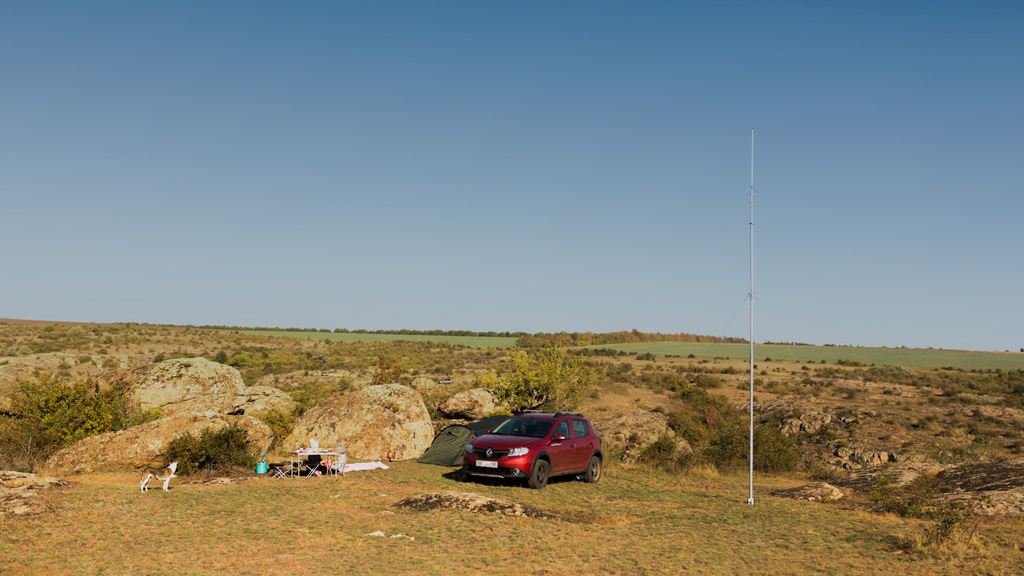 The Shpyl-8K mast
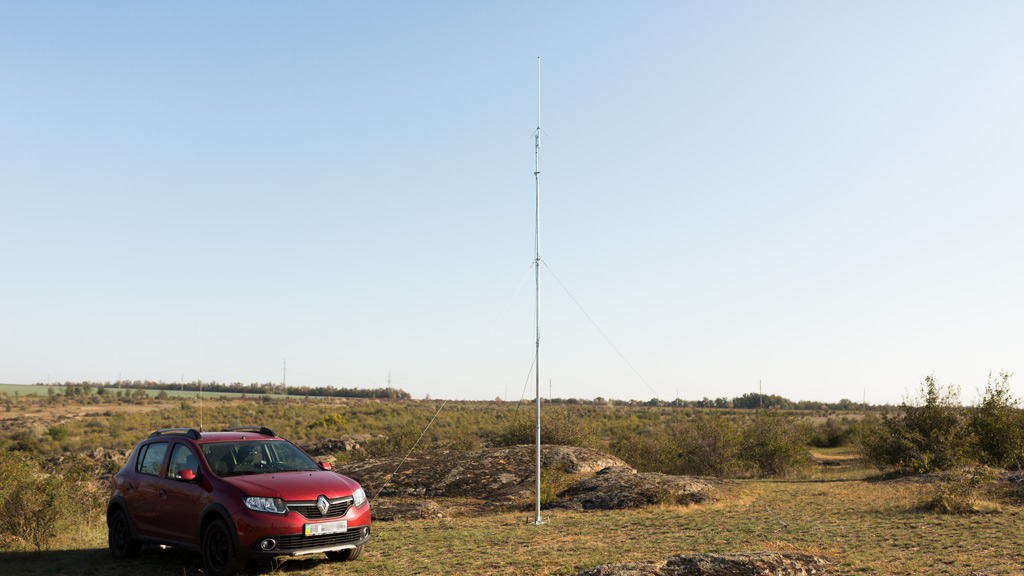 The Shpyl-8K mast with a Storm UV-100 antenna
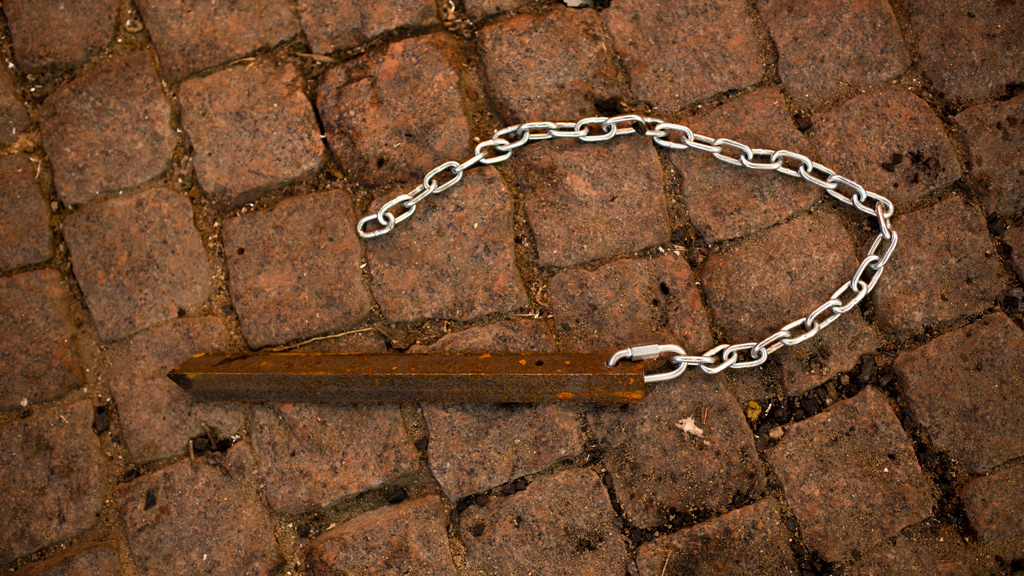 One way to make stakes for the guy ropes
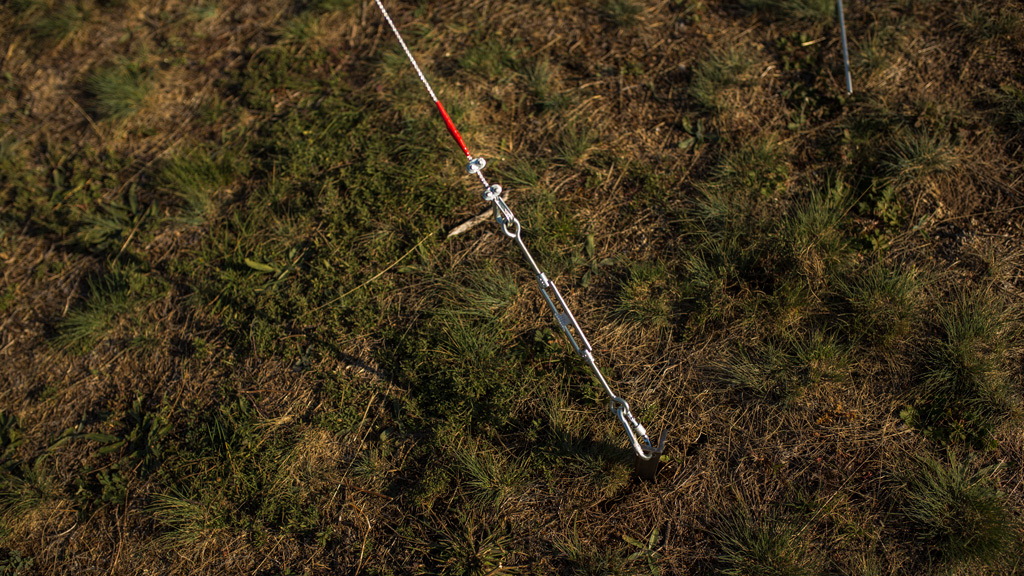 Guy rope attachment with turnbuckles
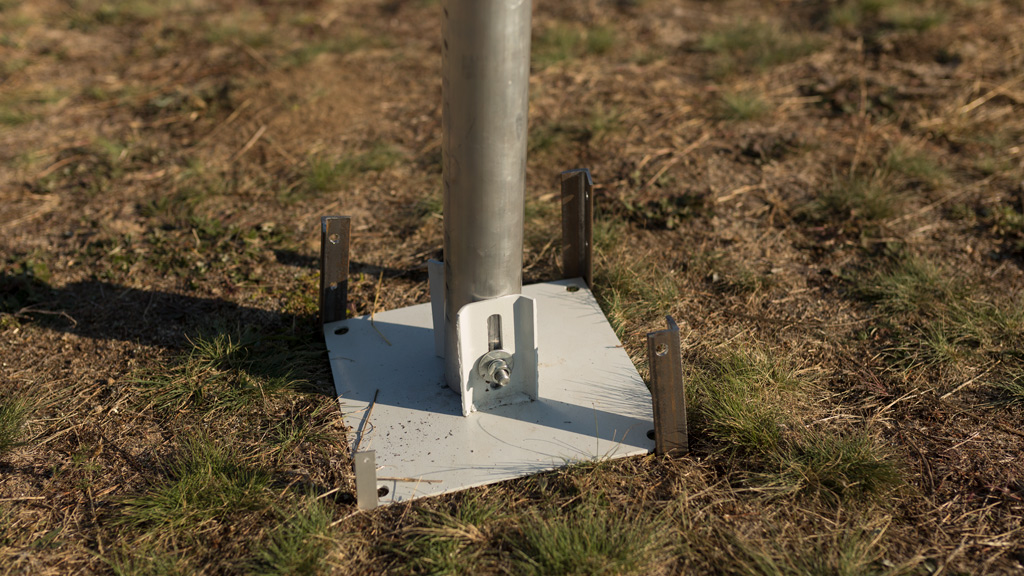 Securing the mast base, almost right