Meteor Scatter Communications: Getting Started
Archive post.
Translated from Ukrainian.
When meteors enter our atmosphere, friction heats them up and they break apart, ionizing the gases around them. The ionized trail can reflect short waves, which makes it interesting as a reflector that temporarily stands in for the ionospheric layers known as the E and D layers, which sit below 150 km. Its density is close to 10,000 electrons/cm³.
Historically, in the 1940s and 1950s, the US military tried to use these ionized trails left by meteors to make long-distance shortwave links and pass aeronautical information, such as convoy tracking or radar data on ionospheric winds.
Knowing about this interest in meteors, radio amateurs have been experimenting in the field since 1953 too. During meteor showers you can hear European hams making QSOs. They use “meteor scatter”, MS (MeteorScatter) for short, also known as “MBC” (Meteor Burst Communications). A contact can last from a few seconds (Pings) to a few minutes (Bursts), and signal strength can range from a few points above the noise floor to several tens of decibels over “59” if the fireball is especially bright.
With meteors you can make long-distance VHF contacts of up to 2500 km. The distance record for a 144 MHz QSO is between GW4CQT (Wales) and UA6MA (Russia), made in CW on August 12, 1977, over 3101 km between the two stations. Thank you, electrons!
The 6 m band (50 MHz) is still the best one to work, because MS signals there are the strongest and last longer than on 2 m (144 MHz). However, because of the wavelength, directional antennas for 6 m cost a bit more than for 2 m, and not every HF or VHF transceiver has 6 m. That’s why you’ll find more MS enthusiasts on 2 m.
At 28 MHz a Burst is 25 times longer than at 144 MHz, and the potential signal energy is 120 times higher than at 144 MHz. At 432 MHz, on the other hand, the same Burst will be 10 times shorter than at 144 MHz, and the signal 30 times weaker.
There is only one restriction: IARU Region 1 (document BM27) has set the band segment for this kind of traffic to 144.020–144.150 MHz for CW and 144.150–144.500 MHz for SSB.
Standard practice for MS contacts is to work either by Sked or Random. A Sked is an arrangement to make a QSO on a set frequency at a set time. If you have internet access, the ON4KST.com chat is the best place for it. In the past, skeds were arranged on 14.345 MHz or 28.345 MHz ± 10 kHz on weekends and throughout the week before major meteor showers, between 11:00 and 14:00 UTC — maybe someone is still there. A typical QSO takes under 5 minutes in CW and about 1 minute in SSB. But for that you need rocks that leave long ionized trails. With digital modes such as FSK441, you can complete a QSO using short Pings.
MS reports
| First digit — ping duration | Second digit — signal strength |
|---|---|
| 1 — Ping with no useful information | — |
| 2 — Ping up to 5 s | 6 — up to S3 |
| 3 — Ping 5–15 s | 7 — S4–S5 |
| 4 — Burst from 15 to 60 s | 8 — S6–S7 |
| 5 — Burst over 60 s | 9 — S8 and above |
Working Random means calling “CQ Contact MS”, or answering a CQ on the same frequency in the same mode — CW, SSB, Digi. During strong meteor showers a QSO takes about 1 minute in CW or 15 seconds in SSB.
In the pre-computer era, most hams used Morse code with “improvements” for meteor scatter QSOs. The message was recorded on magnetic tape and sent on the air at high speed (high speed CW, HSCW) — around 10–1000 words per minute. The record is 3320 words per minute. The other station recorded the band on a tape recorder and played it back at a lower speed. Later, computers took over this job. For CW fans, I’d suggest looking at WinMSDSP, which lets you work CW at speeds up to 4000 words per minute.
The Zenithal Hour Rate (ZHR) of meteors varies a lot depending on the shower, the type of meteors (sporadic or not) and the time of day, so it’s best to make QSOs during periods of high ZHR. The three main showers are the Quadrantids in January, the Perseids in August and the Geminids in December. You can find the rest here.
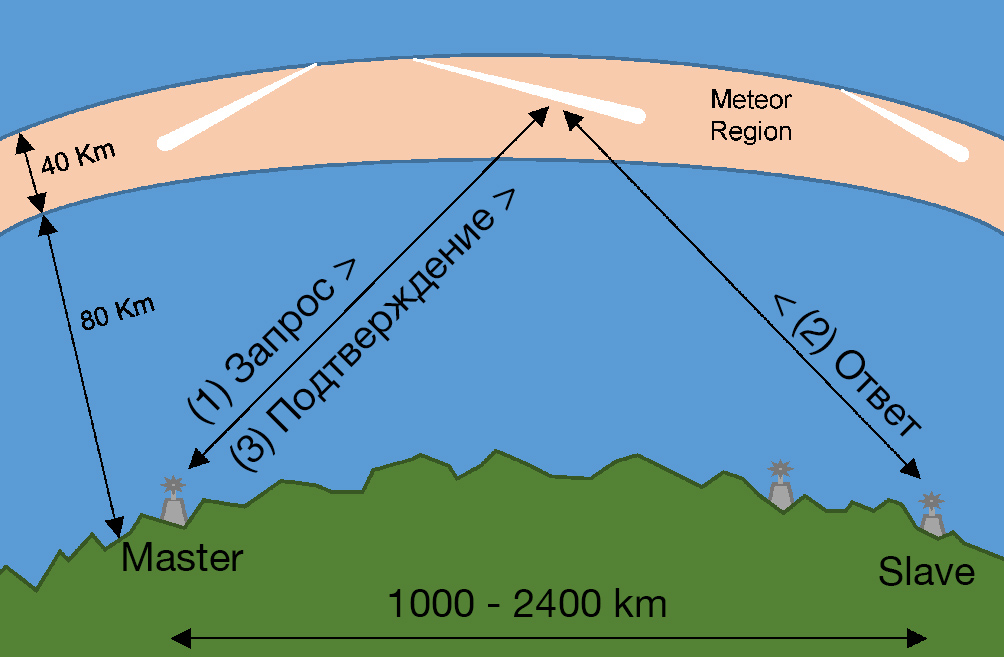
During showers, the position of the meteor path also determines how far you can work. The imaginary point in the sky that meteors appear to come from is called the radiant (nothing happens at it, but everything happens around it). It depends on the observer’s latitude and should be as low as possible if you want to work a very distant station several thousand kilometers away.
Once you’ve arranged a Sked, point your antenna perpendicular to the shower — that ensures a successful MeteorScatter QSO.
The summer months are the most favorable for MS activity because of strong ionization of the ionosphere. Mid-August is the best time for MS contacts, as it brings the famous Perseid meteor shower. But don’t try to work MS stations too early in the evening, because most meteors hit the Earth after midnight. Between 01:00 and sunrise, the leading side of the Earth sweeps up far more meteors, and they enter the atmosphere at higher speeds than on the opposite side, where meteors have to catch up with the Earth in its orbit. That’s why in the morning there are more meteors, the fireballs are bigger, and their trails are brighter than before midnight.
To be continued…